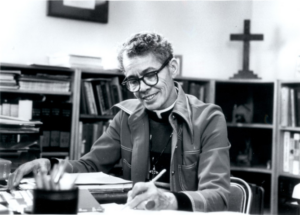
When I was asked to write about books on my bookshelf for Black History Month, there were so many titles that immediately came to mind. Howard Thurman’s landmark work Jesus and the Disinherited remains vital and challenging, as does James Cone’s The Cross and the Lynching Tree and Cole Arthur Riley’s This Here Flesh. But the book that I want to highlight is Songs in a Weary Throat, by Pauli Murray.
Songs in a Weary Throat is Pauli Murray’s memoir, and it was first published posthumously in 1987. It tells her story, starting in Baltimore and Durham, North Carolina, continuing on to New York City, to our city, Washington, DC where she attended law school at Howard, and follows her for the rest of her amazing life.
The more you learn about Pauli Murray, the more you may wonder why you hadn’t heard about her before.
She was arrested for refusing to leave a whites-only section in on a Virginia bus in 1940. She led sit in protests in Washington, DC to desegregate lunch counters in Washington, DC in 1943. While at Howard, in 1944, she first articulated the theory the segregation was unconstitutional under the 14th Amendment under the theory that separate was inherently unequal. A position that was initially dismissed until it became the theory used by attorneys in Brown vs the Board of Education. Pauli Murray’s concept of “Jane Crow,” and highlighting the sexism of her time would go on to influence people such as Ruth Bader Ginsburg, who listed Pauli Murray as an honorary co-author in her landmark brief for Reed vs Reed. Pauli Murray also had a deep friendship with Eleanor Roosevelt, where she consistently challenged the Roosevelt administration to act more justly. As if that weren’t enough, Pauli Murray’s call for an NAACP for Women inspired Betty Friedan to start the National Organization for Women, and Pauli Murray was a founding member.
Pauli Murray refused to accept injustice anywhere. While others were celebrating the March on Washington, Pauli Murray spoke about how women were marginalized in the planning and the march itself in a way that she found “bitterly humiliating.”
Throughout her life, Pauli Murray was guided by her faith. For the last phase of her amazing life, she turned her attention to her church, the Episcopal Church, and challenged it to recognized that God had also called women into the ministry. As in all aspects of her life, when Pauli Murray saw injustice, she refused to let it go and pressured the Episcopal Church to ordain women. Pauli Murray was in the first class of women ordained into the Episcopal Church in 1977, in a ceremony at the National Cathedral here in Washington, DC.
Pauli Murray was an amazing writer, and that comes through in her memoir. She led an amazing life, and one that deserves to be known and celebrated by more people.
Personally, Pauli Murray is one of my saints, and I have an icon of her in my dining room. Her life and writings continue to challenge and inspire me.
-Charles Anderson-Gray
Pauli Murray’s Poem “Dark Testament Verse 8” where the title of her book comes from







Leave a Reply